whoot.
Venues & eventsIncident managementMartyn's LawPricingFeatures
Sign inStart free
Venues & eventsIncident managementMartyn's LawPricingFeatures
Sign inStart free

See the incident, not just hear it.

whoot. transforms live voice communications into a real-time intelligence picture. AI extracts entities, tracks threats, analyses sentiment and correlates reports, as your teams speak.

Start free trialRequest a demo14 days · full access · no card
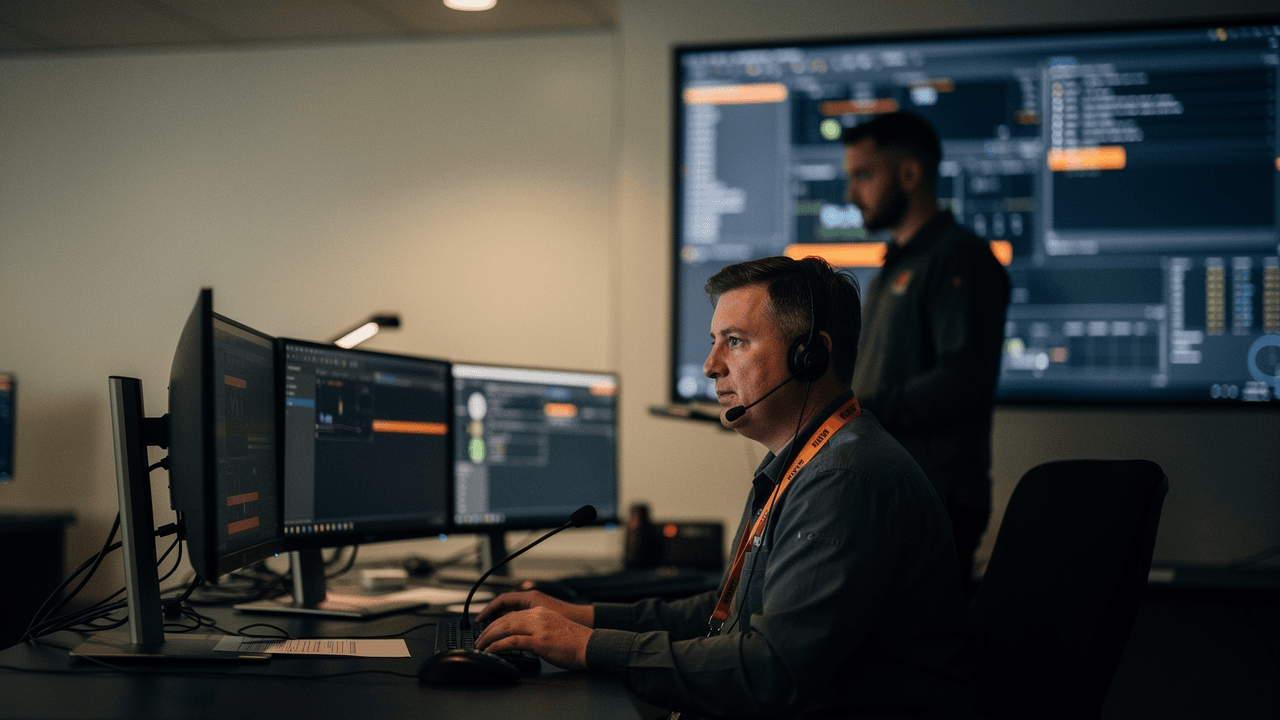
An operator in a headset working across dark dashboard monitors in a control room
Event control.
  • Intelligence automated, from the first word
  • Entity extraction in under 8 seconds
  • 30+ languages
  • 1536-dimension embeddings for corroboration
Sheet 1From declaration to debrief · The intelligence pipeline
Detect

Declared

An incident is declared; extraction activates on every utterance.

Declare an incident from the dashboard or a phone. Intelligence extraction switches on automatically and the AI begins processing every word spoken on the incident’s rooms, extracting actionable intelligence in under 8 seconds.

Speech-to-text
Live streaming speech-to-text with word-level timestamps and speaker diarisation.
Speaking rate
The voice server computes speaking rate (words per minute) from the word timestamps as each message is stored.
Extraction
Every stored message triggers the extraction pipeline with its context.
AI engine
Extracts entities (threats, weapons, casualties, locations) and runs sentiment analysis.
Corroboration
1536-dimension semantic vectors score corroboration across independent reports.
Broadcast
Intelligence and sentiment updates stream to every operator's dashboard.
Declared
Coordinate

Field teams

Field teams report by push-to-talk; entities, sentiment and locations stream to the dashboard.

Traditional incident response relies on operators manually piecing together radio traffic. whoot. does it automatically: extracting entities, tracking threats and analysing vocal stress in real time, while operators confirm and disseminate.

Extraction
<8s
Semantic vectors
1536-dim
Languages
30+
Stress analytics
WPM and sentiment
Live
Analyse

Corroboration

Independent reports are linked; patterns and escalation surface as they form.

The corroboration engine links independent reports about the same entity and raises the score as evidence mounts, separating a rumour from a confirmed fact. Phrase heatmaps surface emerging patterns. Stress analytics flag escalation before it is reported.

Corroborated
Review

Replay

Replay every second; learn from every incident.

Full gap-compressed timeline replay with synchronised audio waveforms, transcription, entity markers, event annotations and vocal stress overlay. Scrub to any moment. Click any transcript line to jump to audio.

  • Speaker-tagged waveforms with playback control
  • Entity markers and event annotations on the timeline
  • Vocal stress colour track overlay
  • AI-generated incident summary and key decisions
  • Exportable transcripts and audit reports
Sealed
Engine

Capabilities

Everything intelligence operators need.

A single platform for real-time situational awareness, entity tracking, stress analytics and post-incident analysis.

AI entity extraction
The AI engine analyses every utterance in real time. Threat actors, weapons, hazards, casualties, locations and requests extracted automatically; no manual tagging.
Vocal stress analysis
Speaking rate from word-level timestamps combined with AI sentiment analysis. Detect stress spikes, panic and escalation in real time.
Threat actor tracking
Deduplicated threat actors with corroboration scoring. Multiple independent reports about the same suspect automatically merged via semantic embeddings.
Location intelligence
All mentioned locations mapped with threat or clear status. See which areas are compromised and which have been cleared, at a glance.
Corroboration engine
1536-dimension semantic vectors for each entity. Multiple independent reports about the same entity are automatically grouped and corroboration scores updated.
Casualty tracking
Live casualty counts aggregated from field reports. Injury types, counts and medical request statuses updated in real time.
Incident replay
Full gap-compressed timeline replay with speaker waveforms, transcription sync, entity markers, event annotations and vocal stress overlay.
Phrase and pattern analysis
N-gram heatmaps surface recurring phrases and themes across all field communications. Detect coordination patterns, repeated threats or escalation language.
Operator workflow
Intelligence operators confirm, dismiss, flag or disseminate entities with a full audit trail. Status-filtered views let operators focus on what matters.
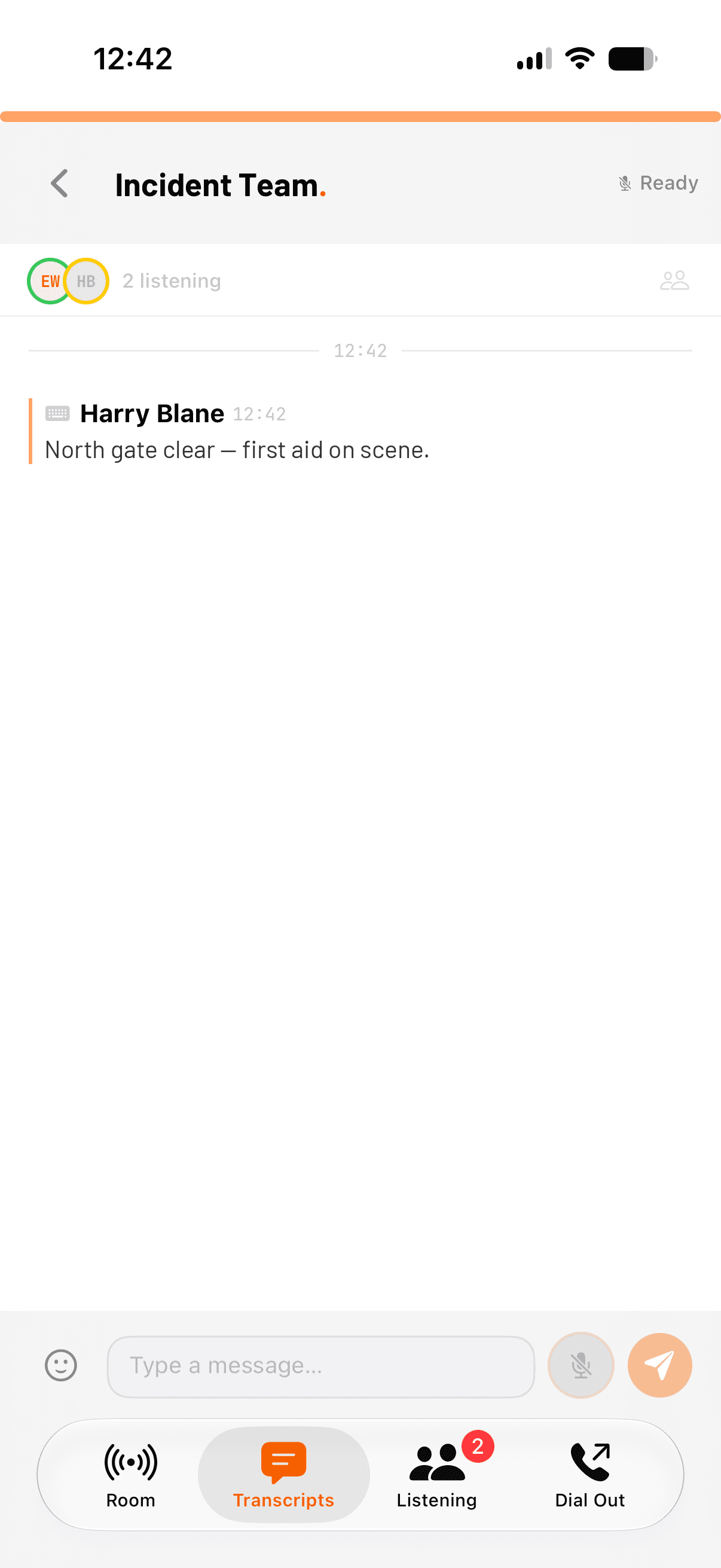
whoot. for iOS: the Transcripts view, each line attributed to its speaker with the recording behind it
Attachment 01whoot. for iOS, Transcripts. Actual screen.
Security

Architecture

Sensitive security communications demand the highest level of protection.

Encryption
DTLS-SRTP for all media streams. TLS 1.3 for signalling. AES-256 encryption at rest. Perfect forward secrecy.
Row-level security
Intelligence data is visible only to operators holding the security operations permission. Fine-grained access control.
50+ RBAC permissions
Define who can view intelligence, manage incidents, replay events or access recordings. SSO, MFA enforcement and full audit trails.
Immutable audit logs
Every entity confirmation, dismissal and dissemination logged with operator, timestamp and IP. Full chain of custody for intelligence.
Scenarios

Built for

From active threats to mass casualty events, intelligence that adapts to the situation.

Active threat response
Real-time threat actor tracking, weapon identification and location intelligence. Coordinate lockdowns, evacuations and armed response with AI-powered situational awareness across every room.
Mass casualty events
Automated casualty counting from field reports with triage status tracking. Medical resource requests flagged and disseminated. Stress analytics detect overwhelmed responders before they report it.
HAZMAT and hazard incidents
Hazard entity extraction identifies chemical, biological or environmental threats. Location tracking maps contamination zones. All-clear reports automatically validated against earlier threat data.
Multi-agency operations
PSTN dial-out bridges emergency services into voice rooms. Cross-agency intelligence shared through the same dashboard. Full recording and audit trail for post-incident review.
Compare

The difference

Traditional methods, and whoot.

Manual radio monitoring and paper-based tracking were never designed for real-time intelligence analysis.

Traditional methods compared with whoot.
CapabilityTraditional methodswhoot.
Situation awarenessRadio chatter and whiteboardsAI-powered intelligence dashboard
Threat identificationManual radio monitoringAutomated entity extraction
Casualty trackingPaper tallies at triageReal-time aggregated counts
Stress detectionSubjective assessmentVocal stress analytics and WPM
Information corroborationCross-referencing notesSemantic embedding engine
Post-incident analysisMemory-based debriefsFull timeline replay and AI summary
Response coordinationWhatsApp groups (minutes)Instant PTT broadcast
Evidence preservationManual note-takingImmutable recordings and transcripts
Multi-agency commsShared radio frequencyPSTN dial-out and bridged rooms
End of sheet 1Back to the top

Radio logs tell you what happened. Intelligence tells you what is happening.

Operators command the response instead of piecing together radio traffic by hand. Every word spoken on a whoot. room during an active incident is processed through the pipeline above.

Voice to intelligence
under 8 seconds
Languages
30+
Corroboration
semantic, across reports
Record
immutable recordings and transcripts

Running a venue or a public event?

The same engine sits under the incident response your venue runs. See how whoot. supports your Martyn’s Law obligations, requirement by requirement.

whoot. for Martyn’s LawWalk one incident end to end

Sheet 2Sign-off
Today

You

Your next incident will happen. See it unfold in real time.

Request a demo to see the intelligence dashboard in action. From voice to intelligence in under 8 seconds.

Signed
Date
Start free trialRequest a demo

14 days · full access · no card

whoot.

Push. Talk. Heard. Incident and crowd management for venues, events and operations, built on an always-on voice core.

  • whoot. on LinkedIn (opens in a new tab)
  • whoot. on Instagram (opens in a new tab)

Product

  • Features
  • Incident management
  • Pricing
  • Roadmap
  • Documentation
  • iOS app (opens in a new tab)
  • Android app (opens in a new tab)

Use cases

  • All use cases
  • Venues & events
  • Incident response
  • Financial services
  • Operations teams
  • Trader voice
  • Martyn's law

Company

  • About
  • Case studies
  • Blog
  • Investors
  • Contact
  • System status

Legal

  • Privacy
  • Terms
  • Acceptable use
  • Security
  • Accessibility

© 2026 Eager Lobster Ltd, trading as whoot. Registered in England and Wales, company number 17038042.

Registered office: First Floor, 1 Des Roches Square, Witan Way, Witney, OX28 4BE. Prices exclude VAT and other applicable taxes.

all systems operational